Why Retail Promotions Are Still Manual — And How Retailers Are Changing That
Why Retail Promotions Are Still Manual
And How Retailers Are Changing That
Retail has embraced digital transformation across customer engagement, analytics, e-commerce, and personalization.
Yet one critical operational function remains largely unchanged: retail promotional operations.
Despite major advances in retail technology, many retailers still rely on manual processes to plan, produce, manage, and execute promotions across channels.
From promotional planning and flyer production to pricing updates and campaign execution, retail promotion workflows often depend on disconnected systems, manual coordination, and time-consuming approvals.
As retail environments become faster and more dynamic, these operational limitations are becoming increasingly difficult to sustain.
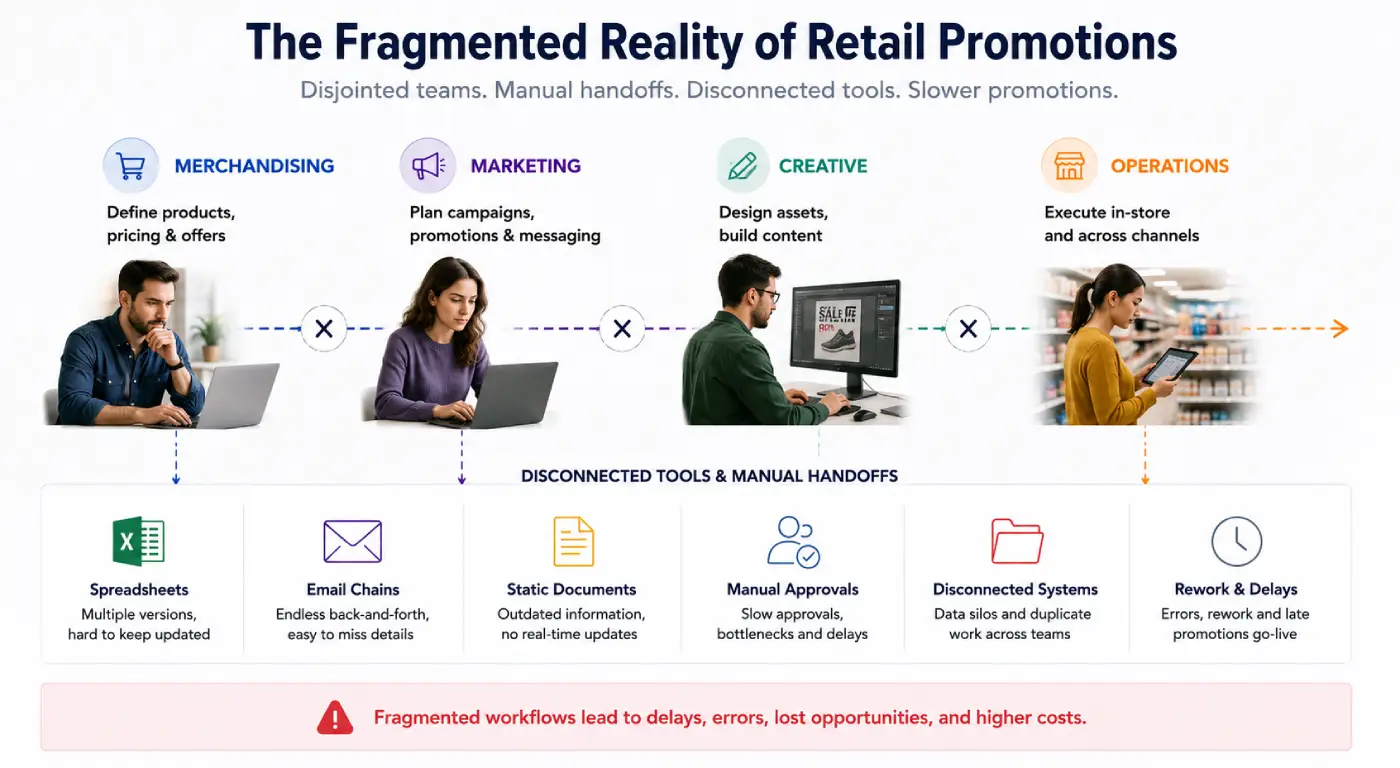
The Fragmented Reality of Retail Promotions
Click image to enlarge
- merchandising teams define products and pricing,
- marketing teams define campaign strategy and promotional messaging,
- creative teams produce promotional assets,
- and operations teams coordinate execution across stores and channels.
However, these functions are rarely connected through a unified promotional operations framework.
Instead, retailers often rely on:
- spreadsheets,
- email approvals,
- static documents,
- disconnected production tools,
- and manual coordination between teams.
Why Retail Promotional Workflows Remain Manual
Lack of a Unified Promotional Operations Platform
Many retail technology platforms focus on customer engagement, campaign activation, or analytics. Few are designed to manage the operational execution of retail promotions.
As a result, promotional planning, production workflows, approvals, pricing management, and execution often happen across disconnected systems.
This creates fragmented workflows that require manual coordination between teams.
Organizational Silos Across Retail Functions
Retail promotions involve multiple departments, but these teams frequently operate independently with limited workflow integration.
Merchandising, marketing, creative production, and operations often use separate systems, processes, and approval structures.
Without connected workflows, retailers become heavily dependent on manual communication and coordination to execute promotions successfully.
Complexity of Retail Data
- pricing,
- product availability,
- inventory,
- promotional rules,
- regional variations,
- and supplier requirements.
This data is often difficult to standardize and synchronize across systems, making automation more challenging.
As a result, many retailers continue to rely on manual updates and operational workarounds.
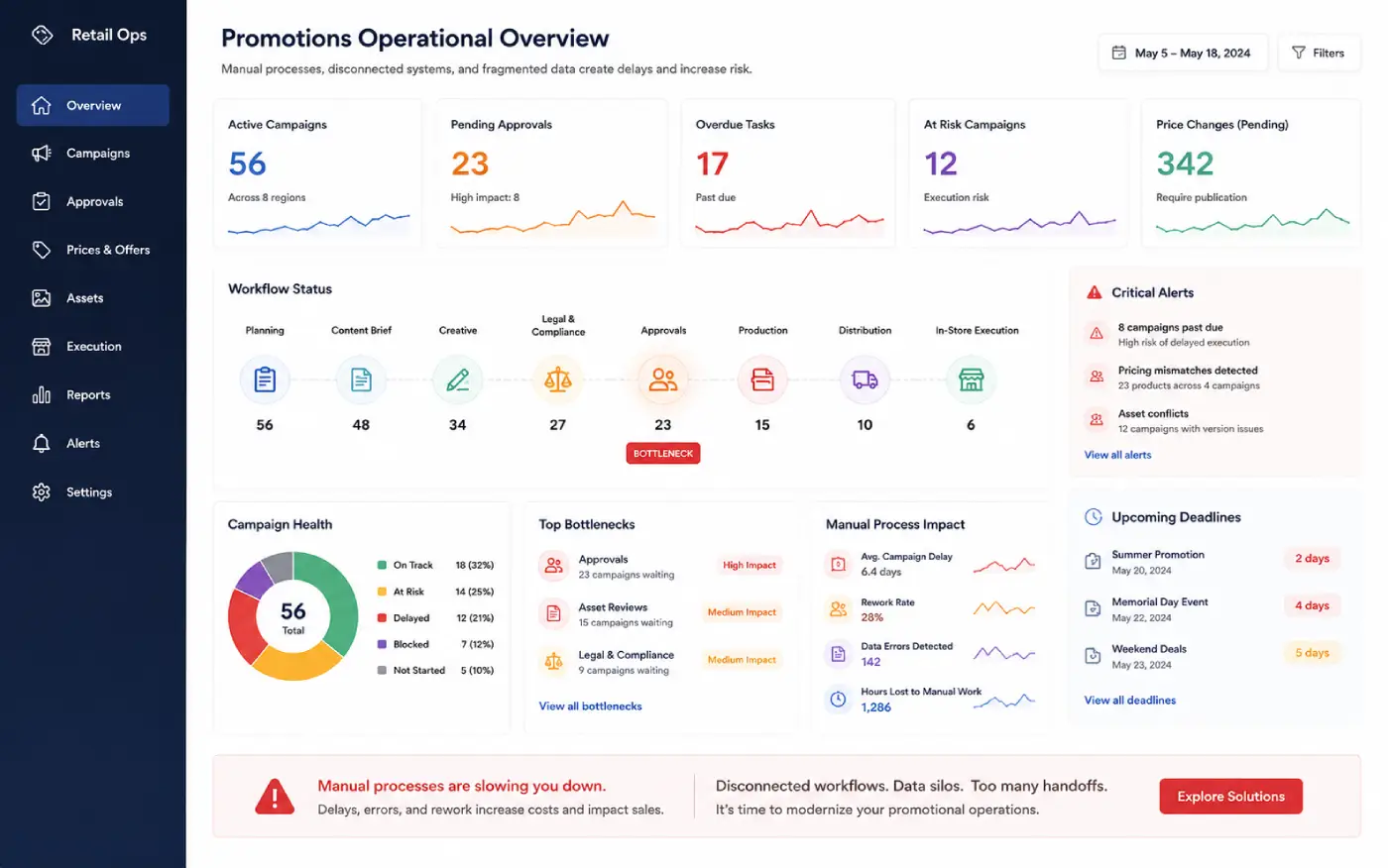
The Operational Impact of Manual Processes
Manual promotional workflows create operational inefficiencies that extend far beyond production effort alone.
Click image to enlarge
- delays in campaign execution,
- increased risk of pricing and promotional errors,
- limited scalability,
- repeated production rework,
- and high dependency on individual knowledge.
These operational limitations reduce promotional agility and make it more difficult for retailers to respond quickly to changing market conditions.
In fast-moving retail environments, execution speed matters. Retailers that depend on disconnected and manual promotional workflows often struggle to adapt promotions in real time, respond to inventory changes, or move quickly against competitors.
The Path Toward Modern Retail Promotional Operations
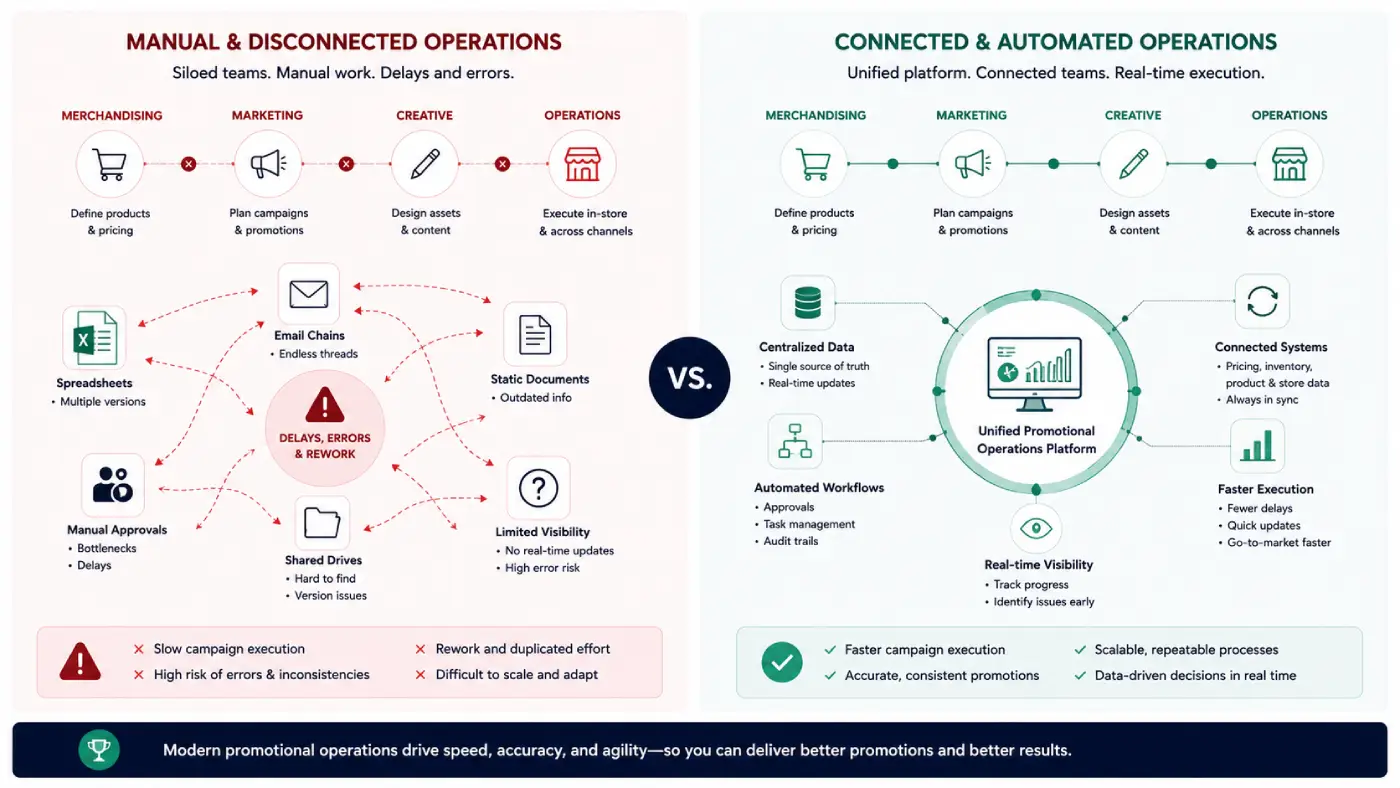
To modernize retail promotions, organizations need operational frameworks that connect planning, production, and execution.
This includes:
- connecting merchandising, marketing, creative, and operations workflows,
- structuring promotional data,
- automating approvals and production processes,
- reducing manual coordination,
- and enabling real-time promotional updates across channels.
Click image to enlarge
Platforms such as ARiSTiD are helping retailers modernize promotional operations by connecting retail data, workflows, and campaign execution processes into more scalable operational models.
By reducing fragmentation and improving workflow connectivity, retailers can improve execution speed, reduce operational complexity, and create more agile promotional operations.
Frequently Asked Questions About Retail Promotional Workflows
Retail promotions often rely on disconnected systems, spreadsheets, manual approvals, and siloed workflows across merchandising, marketing, creative, and operations teams.
Manual promotional workflows can create delays, production rework, operational inefficiencies, pricing errors, and limited scalability across retail operations.
Retail promotions depend on complex and constantly changing data such as pricing, inventory, regional variations, and supplier requirements, which can be difficult to standardize across systems.
Retailers are modernizing promotional workflows by connecting teams, structuring promotional data, automating workflows, and enabling real-time campaign updates across channels.
Conclusion
Retail promotions are not manual because they need to be manual.
In many cases, they remain manual because retailers lack the operational frameworks, connected workflows, and systems required to support scalable promotional execution.
Retailers that address this gap can improve operational efficiency, reduce production complexity, and execute promotions with greater speed and agility.
As retail environments continue to evolve, modernizing promotional operations is becoming an increasingly important competitive advantage.
Ready to get started?
TL;DR article summary
Despite digital transformation across retail, promotional operations remain manual due to fragmented systems and organizational silos, creating delays and errors that limit agility.
Retail promotions involve disconnected teams (merchandising, marketing, creative, operations) relying on spreadsheets and manual approvals instead of integrated workflows. This fragmentation causes delays, pricing errors, limited scalability, and difficulty adapting to market changes in real time.
Modernizing requires unified operational frameworks that connect workflows, structure promotional data, and automate approvals—platforms like Aristid enable retailers to integrate retail data and campaign execution into scalable models with real-time updates across channels, improving execution speed and creating competitive advantage in fast-moving retail environments.
Sales Inquiries + 1 (514) 223 3648
sales@munvo.com
© 2026 Munvo is a trademark of Munvo Solutions Inc.