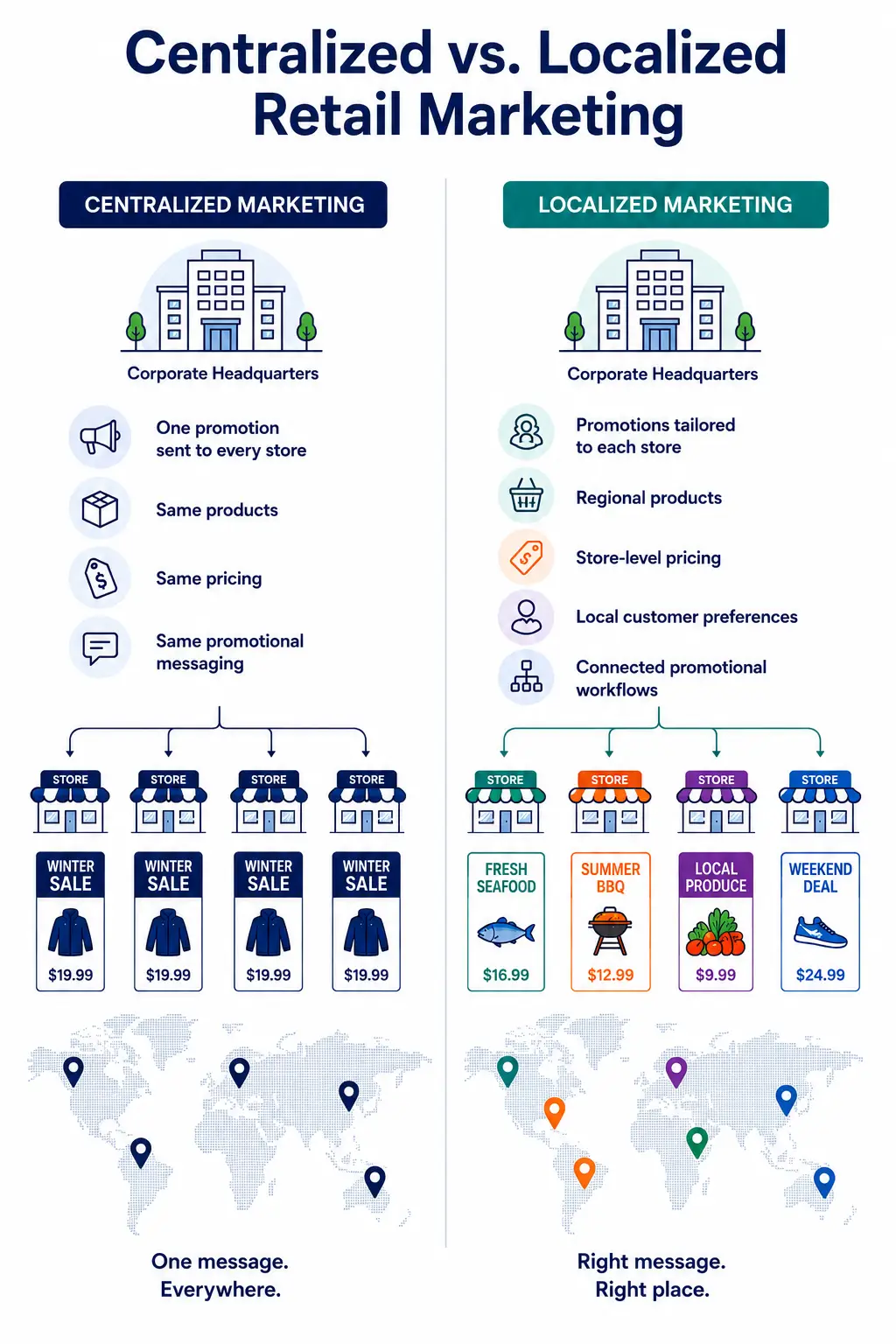
Customer preferences, purchasing behavior, and demand patterns vary from one store to another. Yet many retail promotional strategies remain centralized, delivering the same promotions and messaging across every location.
While centralized marketing provides consistency and operational efficiency, it doesn’t always reflect the realities of individual stores or local markets.
As customer expectations continue to evolve, retailers are looking for ways to deliver more relevant experiences without sacrificing operational control.
The Centralization Challenge
Centralized retail marketing plays an important role in helping organizations maintain brand consistency, simplify campaign execution, and ensure operational governance across hundreds or even thousands of locations.
However, this approach often comes at the expense of local relevance.
Stores serve different communities, experience different purchasing behaviors, and respond to different demand patterns. A promotion that performs well in one region may be less effective in another.
Finding the right balance between centralized control and localized execution has become one of the biggest challenges in modern retail marketing.
Why Localized Retail Marketing Matters
Localized retail marketing enables retailers to better align promotions with the unique needs of individual stores and local markets.
Rather than delivering identical campaigns everywhere, retailers can adapt promotions based on regional preferences, store-level demand, and local buying behavior while maintaining a consistent brand experience.
The value of delivering more relevant experiences is well established. According to McKinsey, companies that excel at personalization can generate 5–15% revenue growth and improve marketing efficiency, highlighting the importance of delivering promotions that reflect customer needs and local market conditions.
When promotions better reflect local conditions, retailers can create more relevant customer experiences that increase engagement, improve conversion rates, and support stronger store performance.
The Challenge of Scaling Localization
While the benefits of localization are clear, scaling it has traditionally been difficult.
For many retailers, localized campaigns have relied on manual adjustments, store-level input, and complex coordination between merchandising, marketing, creative, and operations teams. As the number of stores, products, and promotions grows, these manual processes become increasingly difficult to manage.
As a result, many retailers have limited localization to only a small number of campaigns or regional initiatives.
A New Approach to Localized Retail Marketing
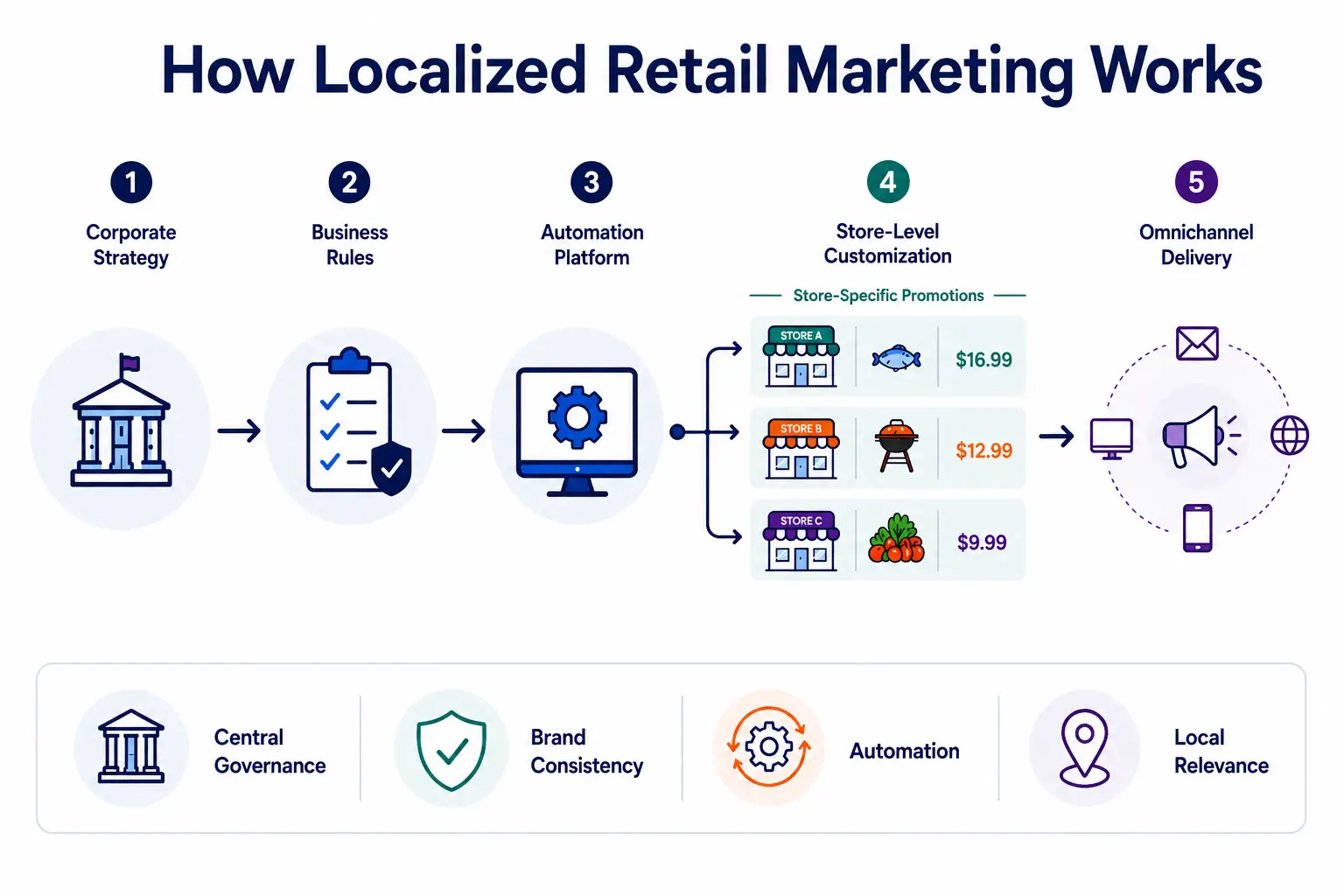
Advances in retail data and workflow automation are changing how retailers approach localization. Retailers can now:
use structured promotional data to create local campaign variations,
automate store-level promotional updates,
maintain centralized governance while enabling local flexibility,
and deliver more relevant promotions without increasing operational complexity.
Rather than choosing between centralized or decentralized marketing, retailers can combine the strengths of both approaches to create promotional strategies that are consistent, scalable, and locally relevant.
Click image to enlarge
Frequently Asked Questions About Localized Retail Marketing
What is localized retail marketing?
Localized retail marketing is the practice of adapting promotions and marketing campaigns to reflect the needs of individual stores, regions, or local customer preferences while maintaining overall brand consistency.
Why is localized marketing important?
Customer preferences, purchasing behavior, and demand vary by location. Localized marketing helps retailers deliver more relevant promotions that better align with local market conditions.
Why has localization traditionally been difficult?
Localized campaigns have often relied on manual processes, store-level coordination, and disconnected workflows, making them difficult to scale across large retail organizations.
How are retailers scaling localized marketing?
Retailers are increasingly using structured promotional data and workflow automation to create localized campaigns while maintaining centralized control and brand consistency.
Conclusion
The future of retail marketing is not centralized or decentralized, it is a balance of both.
Retailers that successfully combine centralized governance with localized execution will be better positioned to deliver more relevant customer experiences, improve promotional performance, and respond more effectively to local market conditions.
Ready to get started?
If you’re looking to scale localized retail marketing without increasing operational complexity, connect with Munvo to explore how modern promotional operations can help deliver more relevant and locally optimized retail experiences.