Moving Beyond Customer Personalization: The Rise of Store-Level Personalization

Moving Beyond Customer Personalization:

The Rise of Store-Level Personalization

Personalization has become a cornerstone of modern retail marketing.

Retailers continue to invest in customer data, analytics, and marketing technology to better understand customer behavior and deliver more relevant experiences. Purchase history, browsing activity, and customer preferences all help create targeted communications that improve engagement.

However, there is an important dimension that traditional personalization often overlooks: operational context.

As retailers work to deliver increasingly relevant customer experiences, personalization must reflect not only who the customer is, but also what can realistically be delivered at the store level.

The Limitation of Traditional Personalization

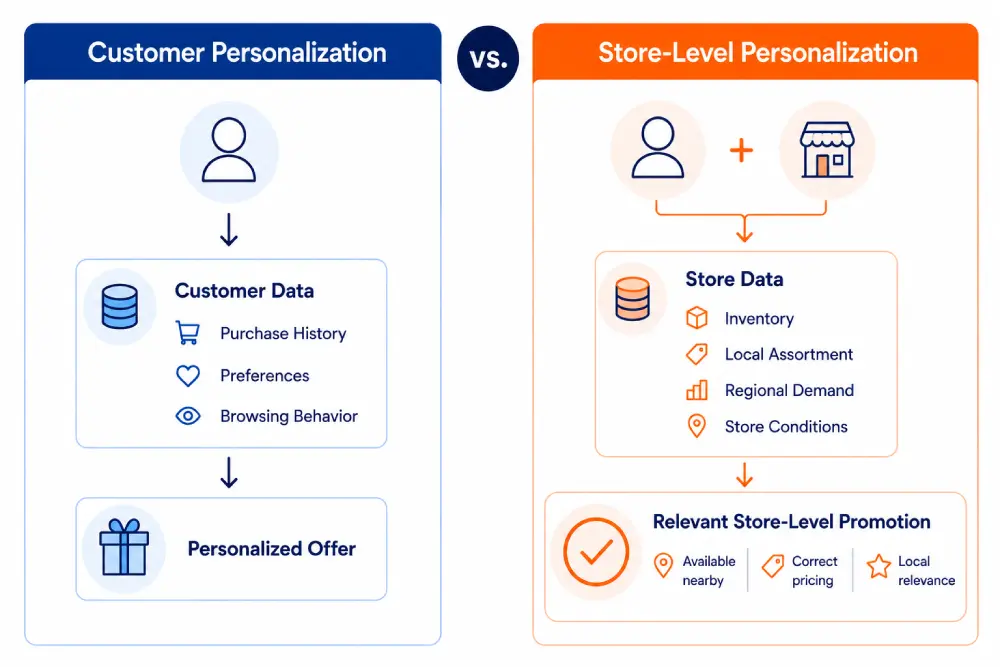
Most retail personalization strategies are built around customer data.

They focus on customer preferences, purchase history, and behavioral insights to determine which products or offers should be presented to each shopper.

Click image to enlarge

While this approach provides significant value, it does not always consider whether a promotion can actually be fulfilled.

If a promoted product is unavailable in a nearby store, priced differently by region, or not part of the local assortment, the customer experience quickly breaks down.

Personalization is only effective when it reflects both customer intent and operational reality.

Introducing Store-Level Personalization

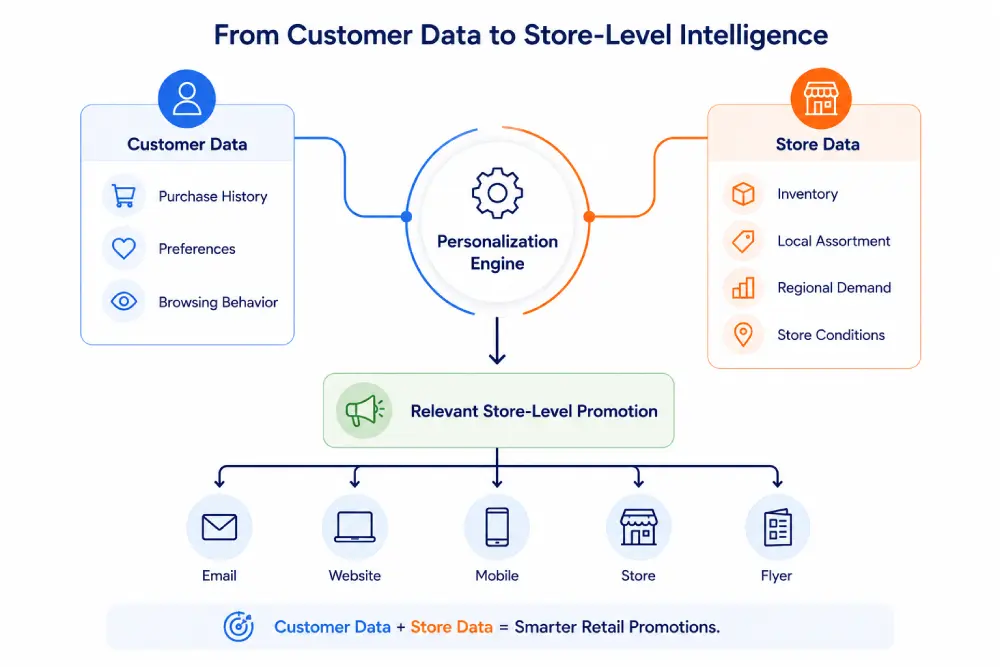
Store-level personalization extends traditional customer personalization by incorporating operational data into the decision-making process.

Click image to enlarge

Rather than relying solely on customer attributes, retailers can also consider:

  • inventory availability,
  • local assortment,
  • regional demand,
  • and store-specific conditions.

This ensures that promotions are not only relevant to individual customers but also feasible for the stores serving them.

By combining customer insights with operational context, retailers can deliver experiences that are both personalized and practical.

Practical Applications

Store-level personalization creates new opportunities for retailers to improve both customer experience and operational efficiency.

Retailers can:

  • promote products that are available in nearby stores,
  • adjust offers based on regional demand,
  • prioritize inventory that needs to move,
  • and deliver promotions that reflect local market conditions.

As customer expectations continue to grow, this level of operational awareness is becoming increasingly important for delivering relevant retail experiences.

Business Impact

When personalization is aligned with store-level operations, retailers can improve both marketing performance and operational efficiency.

This approach helps deliver:

  • higher conversion rates,
  • reduced customer frustration caused by out-of-stock products,
  • improved inventory efficiency,
  • and stronger alignment between marketing and retail operations.

Rather than treating marketing and operations as separate functions, store-level personalization helps connect both teams around a shared view of what customers can realistically purchase.

Frequently Asked Questions

What is store-level personalization?
Store-level personalization combines customer data with operational information such as inventory, pricing, assortment, and regional demand to deliver more relevant retail experiences.
How is store-level personalization different from customer personalization?
Traditional customer personalization focuses primarily on customer behavior and preferences. Store-level personalization also considers operational conditions that affect whether an offer can actually be fulfilled.
Why is operational context important?
Operational context helps ensure that promotions reflect inventory availability, local assortment, and store-specific conditions, improving both customer experience and marketing effectiveness.
What are the benefits of store-level personalization?
Retailers can improve promotional relevance, reduce out-of-stock frustration, increase conversion rates, improve inventory efficiency, and better align marketing with retail operations.

Conclusion

True personalization goes beyond understanding the customer.

It requires aligning customer insights with the operational realities of the retail environment.

Retailers that combine customer data with store-level intelligence will be better positioned to deliver more relevant experiences, improve promotional performance, and strengthen the connection between marketing and retail operations.

If you’re looking to move beyond traditional customer personalization, connect with Munvo to explore how modern promotional operations and retail technology can help deliver more relevant, store-level customer experiences.

Sales Inquiries + 1 (514) 223 3648
sales@munvo.com

© 2026 Munvo is a trademark of Munvo Solutions Inc.


Munvo | The Marketing Solutions Specialists
Search