What We Learned About AI Governance and Data Modernization at the SAS MONSUG Conference 2026
What We Learned About AI Governance and Data Modernization at the SAS MONSUG Conference 2026
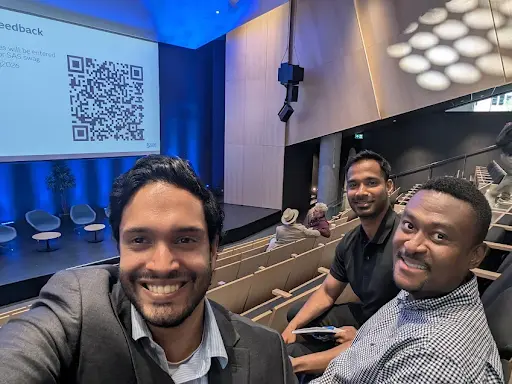
Moving beyond the typical AI buzzwords, the conference focused on practical execution, regulatory compliance, and building governance frameworks that ensure data and AI can be trusted at scale.
Here are the key themes and takeaways that stood out from our experience at the event.
Why AI and Data Modernization Projects Fail
One of the most grounding moments of the conference came during a discussion on why so many analytics modernization and AI initiatives stall. Data modernization sounds promising on paper, but execution remains one of the biggest challenges facing enterprise organizations.
As highlighted during the presentation, industry research shows that 70% to 80% of corporate business analytics projects fail. Furthermore, Gartner projections warned that by the end of 2025, half of GenAI initiatives would be abandoned after the proof-of-concept (POC) phase, while up to 40% of Agentic AI projects could be canceled by 2027.
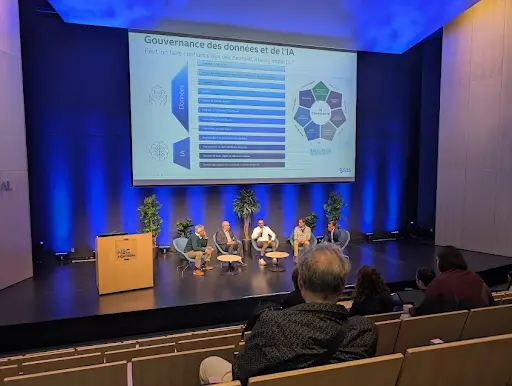
The takeaway was clear: technology alone cannot bridge the gap. Successful modernization requires a fundamental shift in how organizations manage their data pipelines, governance practices, operational readiness, and organizational culture.
For organizations investing in AI, governance should not be viewed as an afterthought. Building governance into modernization efforts from the beginning helps reduce operational risk while creating a stronger foundation for long-term success.
Navigating the New Era of Model Risk (OSFI E-23)
The Office of the Superintendent of Financial Institutions (OSFI) is the federal regulator responsible for supervising banks, insurance companies, and trust companies in Canada. For financial institutions and other highly regulated industries, the conference highlighted how the OSFI E-23 guideline is fundamentally changing expectations around model risk management.
- Expanding the Scope: E-23 broadens the definition of a “model” beyond traditional quantitative models to include AI, machine learning, judgment-based models, and third-party solutions.
- A Modern Vision for Risk Management: Organizations must move beyond siloed controls toward enterprise-wide lifecycle governance, automated validation, and risk-based oversight.
- Core Focus Areas: Building a resilient E-23 framework requires strong data and AI foundations, rigorous testing, continuous monitoring, risk classification, and maintaining an enterprise-wide inventory of analytical models.
This shift fundamentally changes the day-to-day reality for both technical and business teams. Data scientists can no longer develop models in isolation – every model, feature, and automated decision requires documentation, validation, and traceability throughout its lifecycle.
While OSFI E-23 may appear to be primarily a compliance initiative, it also has significant implications for marketing and customer experience teams. Organizations increasingly rely on AI for customer segmentation, next-best-action recommendations, and predictive analytics, making collaboration between marketing, analytics, and governance teams more important than ever.
How Organizations Can Build an AI Governance Roadmap
As organizations continue deploying AI at scale, one question echoed throughout the conference:
Can we truly trust our data-driven decisions and their downstream impacts?
To address this challenge, speakers introduced structured AI governance frameworks designed to help organizations mature their governance capabilities over time.
One example was an AI Governance Roadmap that balances foundational, responsive, proactive, and leadership capabilities across four critical dimensions:
- Oversight
- Compliance
- Operations
- Culture
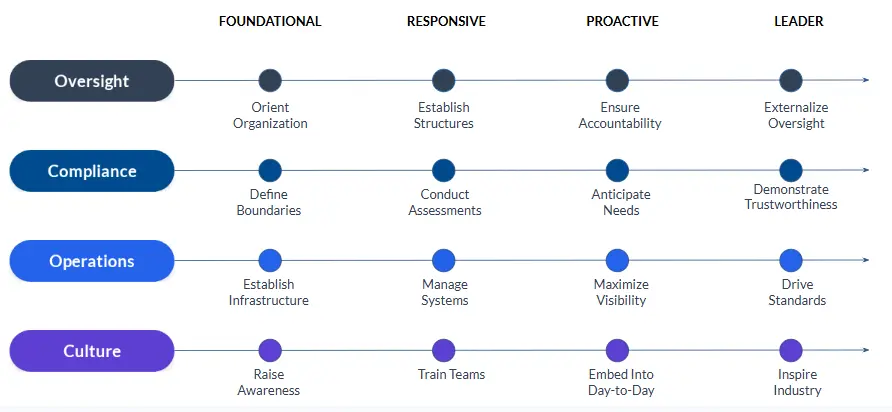
This roadmap was complemented by the Info-Tech governance framework, emphasizing that AI governance cannot exist independently. Effective AI governance depends on strong data quality, metadata management, lineage, cataloging, traceability, and security.
Rather than treating governance as a compliance exercise, organizations should view it as an operational capability that enables AI to scale responsibly and consistently across the enterprise
Collaborative Insights from Industry Leaders
One of the highlights of the conference was a panel discussion bringing together perspectives from academia, banking, and consulting.
Panelists shared real-world experiences about balancing rapid innovation with growing regulatory expectations. A recurring theme was the importance of collaboration: data scientists, governance teams, risk officers, and business leaders must speak the same language if organizations want to successfully scale AI initiatives.
The discussion centered around a key question:
“Data and AI Governance: Can We Trust Decisions and Their Impacts?”
The panel emphasized that trust cannot be achieved by governing AI in isolation. Instead, organizations must connect traditional data governance disciplines, including data cataloging, lineage, quality management, and security, with AI-specific governance practices such as model transparency, bias mitigation, explainability, and lifecycle risk management.
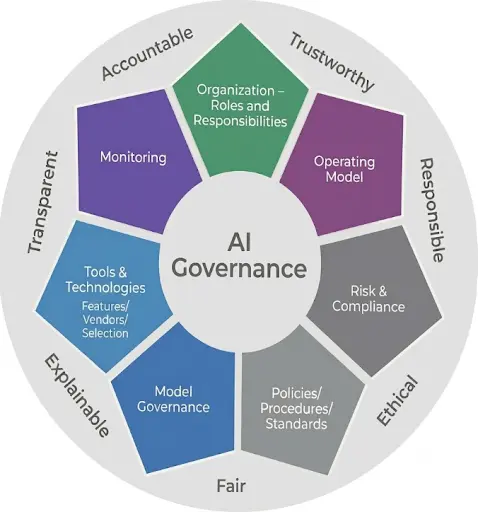
The Info-Tech AI Governance framework presented during the session reinforced that AI systems are only as effective as the governance surrounding them. Mature organizations balance clearly defined operating models, governance roles, compliance processes, and continuous monitoring with broader principles of accountability, transparency, fairness, responsibility, and ethical AI.
Final Thoughts
The SAS MONSUG conference proved that the conversation around AI has fundamentally matured. The question is no longer about what AI can do, but how we can govern, validate, and trust what it is already doing.
By focusing on robust governance frameworks, staying ahead of regulations like OSFI E-23, and breaking down organizational silos, companies can transform data governance from a bureaucratic hurdle into a competitive advantage.
Frequently Asked Questions
Ready to Build a Trusted AI Governance Strategy?
TL;DR article summary
AI governance must be built into modernization from the start—70-80% of analytics projects fail without it, and OSFI E-23 now requires enterprise-wide lifecycle governance for all AI/ML models with full traceability.
SAS MONSUG 2026 emphasized that technology alone cannot succeed; organizations need robust governance frameworks balancing oversight, compliance, operations, and culture. OSFI E-23 expands model risk management to include AI, ML, and third-party solutions, requiring documented, validated, traceable models throughout their lifecycle.
Gartner projects 50% of GenAI and 40% of Agentic AI projects will fail by 2027, proving AI governance requires strong data quality, metadata management, and lineage combined with model transparency, bias mitigation, and explainability. Success depends on breaking organizational silos so data scientists, governance teams, and business leaders collaborate with shared accountability and language.
Sales Inquiries + 1 (514) 223 3648
sales@munvo.com
© 2026 Munvo is a trademark of Munvo Solutions Inc.