Personalization in Retail Marketing: From Mass Messaging to Meaningful Relevance
Personalization in Retail Marketing: From Mass Messaging to Meaningful Relevance
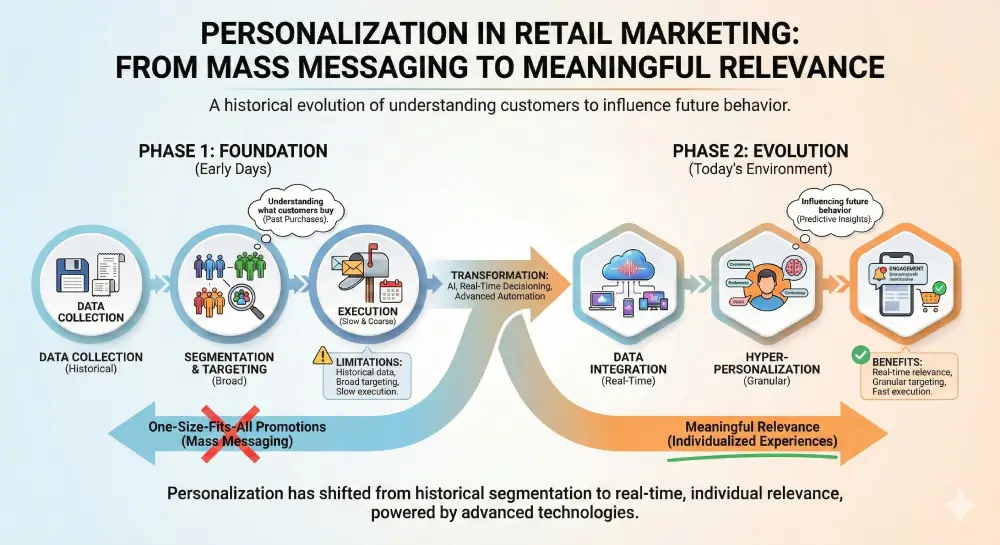
Personalization in retail marketing did not begin with artificial intelligence, real-time decisioning, or advanced automation. It began with a far simpler idea: understanding what customers buy and using that knowledge to influence future behavior.
In North America, the earliest form of personalization took shape through loyalty programs and database marketing. Retailers collected transactional data, grouped customers into segments, and delivered targeted offers based on past purchases. For its time, this approach was powerful. It helped retailers move away from one-size-fits-all promotions and toward more relevant communication.
That first wave of personalization laid the foundation for everything that followed. But it was also limited. The data was historical, the targeting was broad, and the marketing execution was slow. Personalization existed, but only at a coarse level.
Today, retail marketing operates in a fundamentally different environment.
Click image to enlarge
Why Personalization Is Accelerating Across Retail
Retailers are under intense pressure from multiple directions at once. Customer expectations continue to rise. Competition is increasingly aggressive. Margins remain thin, especially in grocery and big-box retail. At the same time, marketing has become a continuous, multi-channel operation that never pauses.
Consumers now expect relevance as a baseline. This expectation for relevance signals a broader shift in retail marketing, where effectiveness is increasingly defined by how well brands align strategy, execution, and operational reality. Research consistently shows that a majority of shoppers expect personalized interactions from brands and feel frustrated when messaging is generic or disconnected from their needs. At the same time, studies reveal a gap between what brands believe they are delivering and what customers actually experience. Many retailers believe they are personalizing effectively, while customers only recognize personalization in a fraction of interactions.
This gap is becoming more visible as digital and physical channels converge. Customers move seamlessly between email, mobile apps, websites, digital flyers, in-store signage, and physical shelves. They expect continuity. When messaging breaks down, trust erodes quickly.
As a result, personalization is no longer a competitive advantage. It is a requirement for relevance.
The Reality Retailers Are Facing
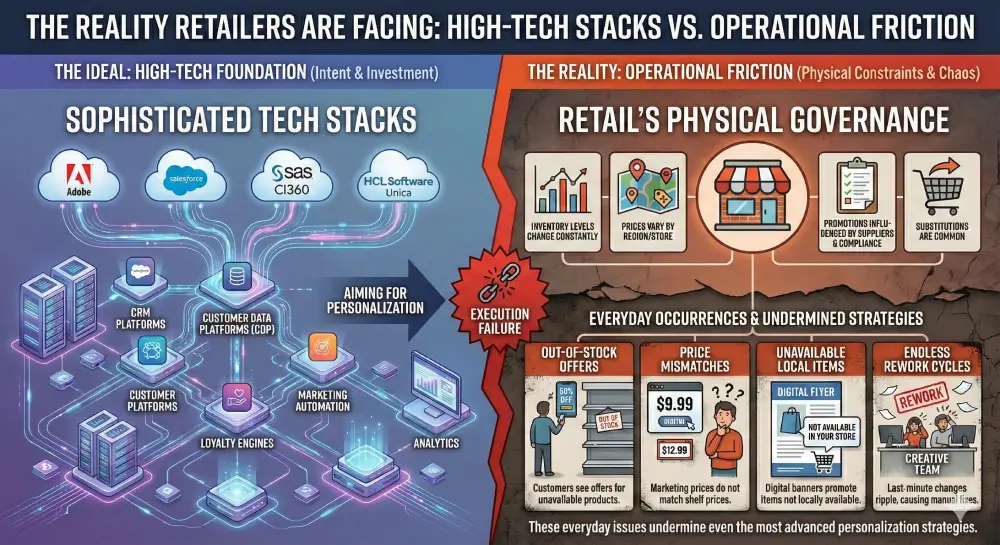
Most North American retailers are not short on technology. They have invested heavily in CRM platforms, customer data platforms, loyalty engines, marketing automation tools, and analytics. Many operate sophisticated stacks built on platforms such as Adobe, Salesforce, SAS CI360, or Unica.
Yet personalization often fails in execution.
The reason is not a lack of intent. It is the operational reality of retail.
Retail is governed by physical constraints. Inventory levels change constantly. Prices vary by region and by store. Promotions are influenced by suppliers, compliance rules, and local regulations. Substitutions are common and often unavoidable. When marketing messages are created without full awareness of these realities, problems surface immediately.
Customers see offers for products that are out of stock. Prices in marketing do not match shelf prices. Digital banners promote items that are not available locally. Flyers require last-minute changes that ripple across every channel. Creative teams are pulled into endless cycles of rework and manual fixes.
These issues are not edge cases. They are everyday occurrences in grocery and big-box retail. And they undermine even the most advanced personalization strategies.
Click image to enlarge
How Personalization Is Evolving
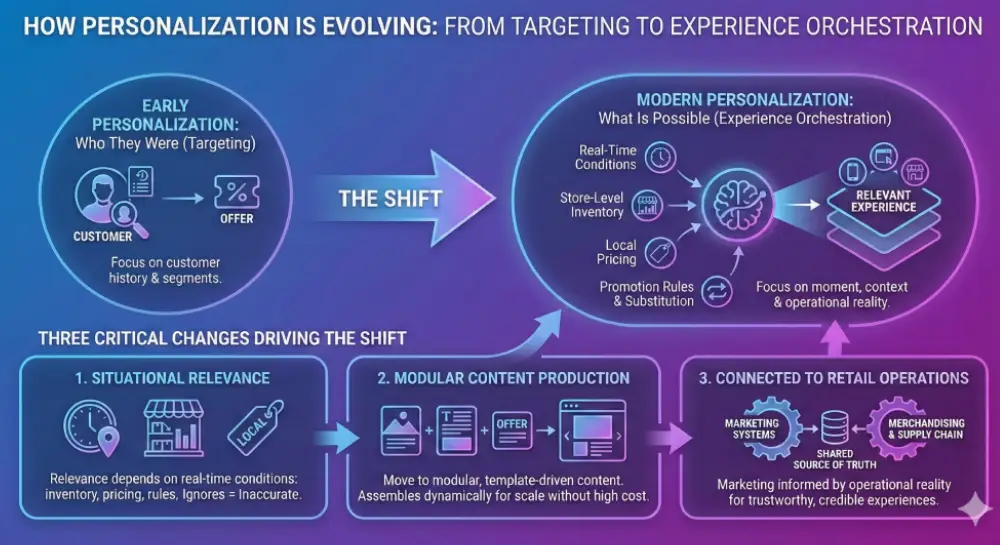
Retail personalization is moving beyond customer targeting and toward experience orchestration.
Early personalization focused on who the customer was. Modern personalization focuses on what is possible in the moment.
This shift is driven by three critical changes.
First, personalization is becoming situational. Customer history still matters, but relevance now depends on real-time conditions such as store-level inventory, local pricing, promotion eligibility, and substitution rules. A personalized offer that ignores these factors risks being inaccurate and ineffective.
Second, content production is changing. Traditional creative workflows were never designed to support thousands of variations across regions, stores, channels, and formats. Leading retailers are moving toward modular, template-driven content that can be assembled dynamically based on rules and data inputs. This allows personalization to scale without proportionally increasing effort or cost.
Third, marketing is becoming more tightly connected to retail operations. To deliver accurate and trustworthy experiences, marketing systems must be informed by the same sources of truth that drive merchandising and supply chain decisions. When marketing reflects operational reality, personalization becomes credible rather than aspirational.
Click image to enlarge
The Role of Disruptive Retail Technology
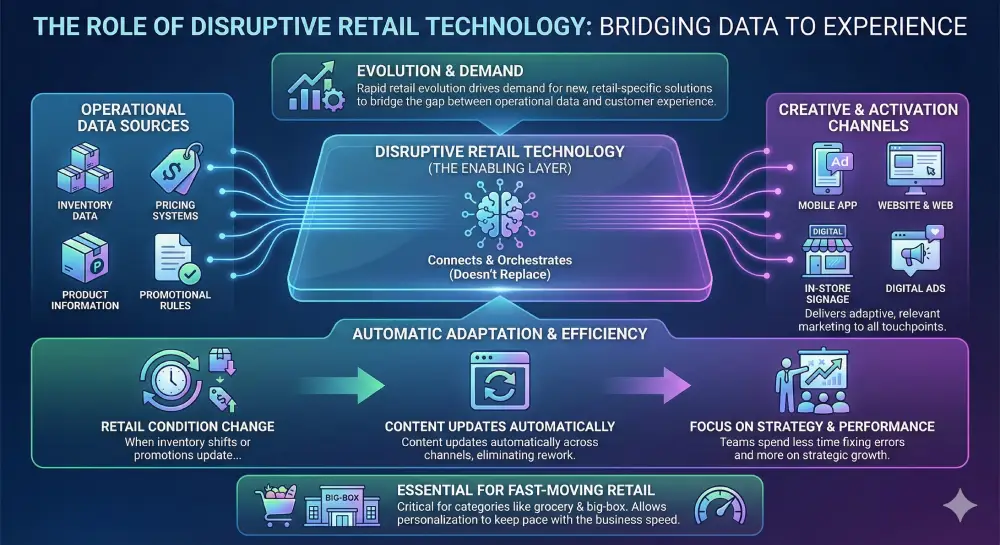
This evolution is driving demand for a new class of retail-specific technology. These solutions are designed to bridge the gap between operational data and customer experience.
Rather than replacing existing marketing platforms, they operate as an enabling layer. They connect inventory data, pricing systems, product information, and promotional rules to creative and activation channels. The result is marketing that adapts automatically as retail conditions change.
This approach addresses one of the most persistent challenges in retail marketing: the cost and complexity of rework. When inventory shifts or promotions change, content updates automatically across channels. Teams spend less time fixing errors and more time focusing on strategy and performance.
For retailers competing in fast-moving categories such as grocery and big-box retail, this capability is becoming essential. It allows personalization to keep pace with the business.
The Business Impact Is Tangible
The value of effective personalization is well documented. Industry research consistently shows that well-executed personalization can drive measurable revenue lift and improve marketing return on investment. However, those gains are only realized when personalization is accurate, timely, and operationally aligned.
Basic personalization techniques such as name insertion or broad recommendations no longer differentiate brands. The impact comes from aligning offers with availability, relevance, and context. Retailers that achieve this reduce customer frustration, improve conversion, and increase trust.
Equally important, they reduce internal friction. Creative teams face fewer last-minute changes. Marketing cycles become more predictable. Errors decline. Costs associated with manual production and correction fall significantly.
Click image to enlarge
How Munvo Helps Retailers Move Forward
Delivering this level of personalization requires more than technology alone. It requires thoughtful integration, clear operating models, and cross-functional alignment.
Munvo works with North American retailers to help them adopt advanced personalization capabilities without disrupting their existing ecosystems. We focus on connecting retail reality with marketing execution.
We help retailers design personalization strategies that are inventory-aware and promotion-correct. We support the implementation of scalable content production models that reduce rework and improve speed. We integrate seamlessly with established MarTech platforms so retailers can build on what they already have rather than starting over.
Most importantly, we help teams operationalize personalization, so it becomes repeatable, measurable, and sustainable.
Looking Ahead
Personalization in retail marketing is entering a new phase. It is no longer defined by how well a brand knows its customers alone. It is defined by how effectively marketing reflects the reality of the retail business.
Retailers that succeed will be those that can deliver relevant experiences grounded in accurate data, supported by automation, and executed at scale. They will move faster, waste less effort, and build stronger relationships with their customers.
For retailers looking to compete in an increasingly complex and demanding market, the path forward is clear.
If you want to explore how modern personalization can work within your retail environment and your existing technology stack, connect with Munvo. We help retailers turn personalization into a practical, high-impact capability that delivers results.
Is Your Personalization Strategy Grounded in Operational Reality or Breaking Down at Execution?
TL;DR article summary
Retail personalization is shifting from historical customer targeting to real-time orchestration that aligns marketing with operational realities like inventory and pricing.
Early personalization used loyalty data and broad segmentation, but modern customers expect real-time relevance across channels. Most retailers struggle because marketing ignores physical constraints—promoting out-of-stock items and mismatched prices—creating rework and eroding trust. Modern approaches use situational relevance with real-time store conditions, modular template-driven content, and direct connections to operational data.
New retail technology bridges this gap by automatically updating marketing content as inventory, pricing, and promotions change—reducing rework, improving accuracy, and delivering measurable results when marketing reflects retail reality rather than just customer history.
Sales Inquiries + 1 (514) 223 3648
sales@munvo.com
© 2026 Munvo is a trademark of Munvo Solutions Inc.